Content Marketing in Australia

“How to develop content that resonates with Australian consumers and boosts engagement.”

Content Marketing in Australia that resonates with Australian consumers … might sound simple. However, you must stop wasting time on content that looks good but doesn’t generate leads. This guide shows Australian small business owners how to develop a digital presence that focuses on solving real customer problems and driving profitable action. By understanding your ideal customer and localising your content, you can build a marketing engine that truly works.

How to develop content that resonates with Australian consumers and boosts engagement.

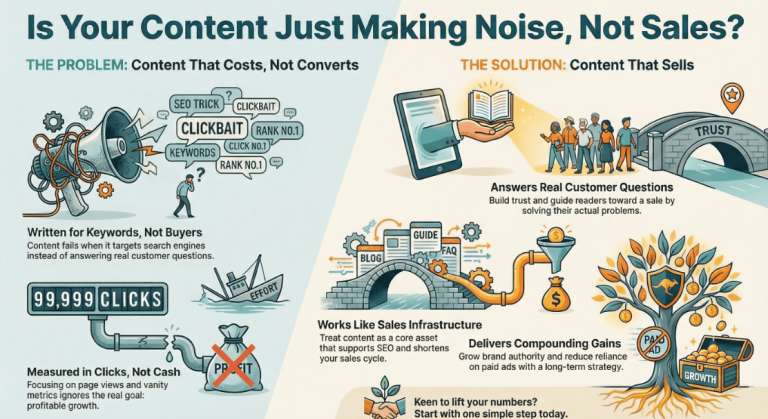
Are you tired of hearing about “engagement,” “reach,” and “brand awareness” without a single one of those fluffy metrics leading to a customer in the door? You’re not alone. I’ve seen countless good businesses… real, honest-to-goodness Aussie businesses—waste time and money on content that makes them feel good but doesn’t make them any money. It’s time we stopped chasing vanity metrics and started building a real marketing engine.

The truth is, most content strategies fail because they’re built for an imaginary customer, not a real Aussie. I’m going to show you how to ditch the generic fluff and create a digital presence that actually turns browsers into buyers.

But what if the problem isn’t your product, but how you’re talking about it?

Crafting Content That Actually Works for Aussies

Let’s have a straight-up chat. You’re busy. You’ve got jobs to quote, staff to manage, and a mountain of other things on your plate. You don’t have time to mess around with marketing strategies that promise the world and deliver a big fat zero. Fair dinkum, I get it.

I’ve worked with countless tradies and small business owners who’ve been burnt by agencies that chased “likes” and “followers.” They’ve spent a motza on campaigns that looked pretty but didn’t put a single extra dollar in the bank. They’ve been told they need to be “disruptive” and “innovative,” but all they really needed was a phone that rang with a real customer on the other end.

My job as your Digital Foreman isn’t to build a fancy website or make your Instagram look good. My job is to make sure your digital presence is a lead-generating machine. I’m here to build you a rock-solid foundation, not a sandcastle that’ll get washed away with the next high tide.

The biggest mistake I see small businesses make? They spend all their time and money talking to themselves.

You might think your ideal customer is just like you. A hard-working Aussie, appreciates a good yarn, and gets a kick out of seeing a job well done. And while that’s a nice thought, it’s a dangerous assumption. Because your ideal customer isn’t you. And acting like they are is costing you leads and a whole lot of time.

Let’s dive into some things I’ve seen work, and some that, frankly, didn’t.

Your Mates Aren’t Your Market: The Customer Persona Myth

I once had a builder client in Melbourne who had a top-notch website, all slick with photos of his best work. The problem was, he wrote all the content for his mates. It was full of industry jargon and assumed the reader knew the difference between a stud wall and a load-bearing one. His leads were flatlining.

When we sat down, I told him we had to forget about what he thought was important. We needed to get into the head of his customer… the young family in the suburbs who didn’t know a lintel from a nail gun.

The family was worried about budget blowout and whether the tradies would be trustworthy. So, we changed the website copy. Instead of talking about “structural integrity,” we talked about “a solid home for your family’s future.” Instead of “compliant building practices,” we talked about “peace of mind that the job is done right.”

  • DIY Approach: Grab a beer and a notepad. Picture your last five best clients. What were they worried about before they hired you? What questions did they ask? Write down their fears, their hopes, and the language they used. That’s your gold. That’s your ideal customer identification. Use their words, not yours.
  • Done For You: This is where a specialist comes in to run some proper market research and audience analysis. We’d interview a few of your previous clients and even some of your competitors’ clients. We can analyse search data to see what questions people are actually typing into Google. The data doesn’t lie.

This approach works whether you’re in the city or out in the sticks. A family in Perth’s northern suburbs wants the same peace of mind as a farmer’s family out past Wagga. Their language might be a bit different, but their core needs are the same.

Content That’s Made for Mobiles, Not Desktops

Picture this: you’re on a work break, maybe with a pie and a can of Fanta. You’re scrolling your phone. You see an article about your industry. Is it a wall of text? You’ll probably swipe right past it. I would.

Your audience, just like you, is reading this stuff on their phone, probably with one eye on the screen and one eye on the job. They want information in quick, digestible chunks.

I worked with an electrician who had a great article on his website about the new electrical standards. It was well-written, but it was a single, long paragraph. A real eye-sore. We broke it up. Short paragraphs, bold headings, and bullet points. Suddenly, his website’s dwell time and conversion rates shot through the roof.

  • DIY Approach: When you write, keep it to a maximum of 3–4 sentences per paragraph. Use headings that tell the story of the article on their own. Break up big chunks of text with bullet points or numbered lists. Think of it like a newspaper headline… quick and to the point.
  • Done For You: A content specialist with a mobile-first design eye can take your existing text and reformat it for better scannability. They can also use tools to check the readability score and ensure your formatting helps with both human readers and search engine crawlers.

The trick is to make your content as easy to consume as a cold beer after a long day. You want to get the point across before they’ve even finished their schooner.

Don’t Just Talk; Show and Tell

Australians are a pragmatic bunch. We appreciate a good story, but we also want to see the evidence. We want to know that what you’re saying actually works.

I had a client, a landscaper, who used to post beautiful photos of finished gardens on his social media. His posts got a few likes, but not a lot of calls. We started a new approach. He started posting short, raw videos. A quick video of him explaining how to pick the right soil. Another of him showing the step-by-step process of laying a new deck. He wasn’t afraid to get a bit of dirt on his hands on camera.

The engagement skyrocketed. People started asking specific questions in the comments. He was building trust, not just a photo album. This is a crucial element of a strong sales funnel and building a community.

  • DIY Approach: Grab your phone and shoot a quick video. Show a before-and-after of a job you just finished. Explain a common problem you solve. Don’t worry about it being perfect. Authenticity beats high-production value every time. The goal is to build trust, not to win an Oscar.
  • Done For You: A digital marketing expert can help you with a full content calendar strategy. We can identify key topics your audience is searching for and plan a mix of videos, images, and short written posts that build a narrative over time, establishing your authority and expertise in the field.

This applies everywhere. A local baker in a small country town could share a video of their morning bake. A city-based plumber could post a video explaining a quick fix for a blocked sink. It’s all about showing people you know your stuff.

It’s About Leads, Not Likes: A Matter of Data

Vanity metrics are the digital equivalent of a shiny new ute with no engine. Looks great, but it won’t get you anywhere. The number of likes on your Instagram post means jack all if it’s not leading to a phone call or an email inquiry.

A client of mine was obsessed with his follower count. His numbers were growing, but his bottom line wasn’t. We sat down and looked at the data. We saw that his most-liked posts were funny memes that had nothing to do with his core business. His actual business-focused posts got less engagement, but the people who did interact with them were far more likely to become customers.We shifted our focus. We created content specifically for his target audience, not for a broad general one. We started a series of posts offering real, practical advice. He lost a few “followers,” but his leads started to pour in. His lead generation was working, and his business was growing. We’d moved from chasing “likes” to chasing actual profit.

The Pitfall of Not Planning for the Seasons

A common mistake I see is a business owner who creates great content but doesn’t time it right. It’s like a roofer posting about gutter cleaning in the middle of a drought—the problem isn’t on their mind. You need to align your content with the seasons and the specific pain points of the moment. For instance, a pool maintenance business should be creating content about winterizing a pool in autumn, not in the middle of summer when everyone’s already in the water. The best way to use your data is to anticipate your customer’s needs and be there when they’re looking for a solution.

  • DIY Approach: Stop looking at your follower count. Look at your website’s analytics. How many people are filling out your contact form? How many are clicking your phone number? That’s your real scoreboard. Set up a simple spreadsheet to track your inquiries and where they came from. It’s a game-changer.
  • Done For You: A specialist can set up sophisticated tracking to show you exactly which marketing efforts are leading to actual, profitable actions. We can analyse your conversion rates and identify which parts of your online presence are working hardest for you. We can even run A/B tests to figure out which messaging is most effective. This is about being smart with your time and money, not just busy.

This is the very essence of a data-driven marketing strategy, where every decision is based on what’s actually working, not on a hunch or what feels good.

Stop Selling the Shovel and Start Selling the Solution

Let’s challenge the whole idea of what you’re selling. A plumber isn’t selling a new pipe or a tap… they’re selling peace of mind that a leak won’t flood a kitchen. A carpenter isn’t selling a piece of wood… they’re selling the idea of a family having a safe, new deck to have a BBQ on.

The content that resonates most isn’t about your product, but about the problem you solve. I worked with a mobile mechanic who was advertising “Engine Diagnostics.” The results were so-so. We changed the message to “Is Your Car Making a Weird Noise? We Can Fix That.” The phone started ringing off the hook. He wasn’t talking about his service; he was talking about the customer’s problem.

Thinking Like a Competitor

I’ll be honest, even I’ve been tempted by these flashy, easy-money solutions. But if I were your competitor, I wouldn’t try to out-do your quality or your personal touch. I’d go for the jugular… your time and your peace of mind. I’d sell a “one-click” marketing solution. I’d use flashy language and promise you a thousand followers in a week. I’d tell you my AI generates all your content for you so you never have to think about it again.

My strategy would be to make your sensible, methodical, “Digital Foreman” approach seem slow and old-school. I’d try to get you to chase a cheap, quick-fix solution that looks great on the surface but has no real foundation. I’d focus on the sizzle, not the sausage. My goal is to get you to buy my low-cost, low-value service and lock you in before you realise it doesn’t actually work.

FAQs for the Smart Business Owner

What’s the best way to start creating content if I’m not a writer?

Start with what you know best. Use your phone to talk about a common question you get from customers. Don’t write it, just say it. Then, get it transcribed. That raw, authentic language is exactly what your audience wants to hear. It’s a great way to kick off your content strategy.

How often should I be posting content to get results?

Consistency beats frequency every time. It’s better to post one high-quality, useful piece of content a week than to post three low-effort pieces that don’t help anyone. Find a rhythm that you can actually stick to, whether it’s weekly or fortnightly. Your audience will thank you for it.

Should I be on every social media platform?

No, mate, you shouldn’t. You should be where your customers are. If your customers are on Facebook, focus on Facebook. If they’re on LinkedIn, focus there. Don’t stretch yourself thin trying to be everywhere. Your time is valuable, and you need to spend it where you’ll get the biggest bang for your buck.

Is digital marketing legal in Australia?

Yes, digital marketing is perfectly legal in Australia. Businesses must adhere to the Australian Consumer Law (ACCC) and privacy legislation. This means being truthful in your advertising, protecting customer data, and providing clear opt-out options for emails.

Digital Foreman’s Bio

I’m the Digital Foreman. Think of me as the person you hire to manage the build of your new home. I come in with a blueprint, a plan, and the best subcontractors in the business. My job is to take the stress of the build off your shoulders so you can focus on your family. In the digital world, that means I manage your marketing so you can focus on your business. I build digital assets that get you profitable actions, not just pretty pictures.